The U.S. cannabis industry generated approximately $33.8 billion in retail sales in 2025, larger than the entire U.S. craft beer market, and is projected to reach $60 billion by 2030. Thirty-eight states now have operational cannabis programs. More than 54 million Americans used cannabis in the past year. By almost any measure, the industry has arrived.
That growth, however, has come with significant operating challenges. Legal cannabis sales declined in 2025 for the first time since legalization began its national expansion. Only 27% of cannabis operators reported profitability in 2024, down from 42% two years earlier. Operators carry more than $2.5 billion in industry-wide debt. Price compression across flower, concentrate, and manufactured goods has squeezed margins across the supply chain, while Section 280E of the federal tax code continues to deny cannabis businesses the standard deductions available to other major industries.

As a result, the businesses sustaining themselves, and positioning for the growth that federal rescheduling and continued state legalization will eventually bring, are the ones that have invested in operational discipline. They have accurate visibility into what their inventory costs, maintain clean compliance records, and make decisions based on data.
For cultivators, manufacturers, and distributors, that foundation starts with cannabis inventory management software. Real-time visibility into inventory, including what you have, where it is, what it cost you, has become a core operational requirement for businesses looking to run efficiently and remain competitive.
This guide covers everything you need to know to understand the category, evaluate your options, and choose the right platform for your operation.
Cannabis inventory management software is a purpose-built digital platform that tracks cannabis and non-cannabis inventory across every stage of the supply chain, in real time, from raw materials through to finished packaged goods and outbound sales orders.
The key phrase is purpose-built. Generic inventory tools like QuickBooks inventory, standard warehouse software, and industry-agnostic ERP platforms weren't designed with cannabis workflows in mind. They track units. Cannabis businesses track plants, packages, harvests, and waste, each with different compliance requirements, units of measure, and cost implications. A generic tool can't handle that without expensive customization, and even then, it won't have a native compliance integration.
Cannabis inventory management software is also different from basic seed-to-sale software, though the terms are often used interchangeably. Seed-to-sale tools are built primarily for compliance. They give state systems like Metrc the data they need. Cannabis inventory management software, especially when embedded in a cannabis ERP, goes much further. It tracks costs, supports production workflows, manages non-cannabis supplies, and feeds directly into financial reporting.

The businesses that need cannabis inventory management software include:
Every state with a legal cannabis program requires operators to report inventory data to a state-mandated track-and-trace system. In most states that is Metrc or BioTrack. The stakes are high: discrepancies between your internal records and what you've reported to the state can trigger audits, financial penalties, or in serious cases, license suspension.
Every plant movement, harvest, transfer, and sale generates a compliance event that needs to be recorded accurately. When those events are tracked manually, or in a system that doesn't sync automatically with the state reporting system, errors accumulate. The further your internal records drift from your compliance records, the more time your team spends on reconciliation.
In most industries, inventory is static. You buy it, store it, sell it. Cannabis moves through a series of stages, each with its own compliance requirements and cost implications: seeds become plants, plants become harvests, harvests become packages, packages become finished goods. At each stage the "inventory" looks completely different: a plant count in week three, a weight-based package in week twelve. Generic software doesn't understand that 500 grams of trim and 500 grams of finished flower are different things, tracked differently, priced differently, and reported differently to regulators.

Cannabis COGS is one of the most financially consequential and most commonly misunderstood challenges in the industry. For cultivators, costs start accumulating before a single plant is harvested: nutrients, labor, overhead, and facility costs all need to attach to the right batches to produce accurate financial data. For manufacturers, input materials, processing costs, and packaging all need to roll into the cost of each finished SKU. Without a system that captures and assigns those costs as inventory moves through production, operators end up without a reliable answer to a basic question: what does it actually cost to produce a given product? In a compressed-margin environment, that gap has a direct impact on pricing decisions, production planning, and financial reporting.

Real-time tracking means your inventory reflects actual, current state across all facilities and licenses, not yesterday's import or this morning's manual count. For cultivators, that spans plant-level data through grow stages. For manufacturers, it captures raw material consumption as production runs are carried out. For distributors, it shows exactly what's on hand across multiple locations at any moment. Without this visibility, inventory decisions are always based on incomplete or outdated information.
The quality of your software's compliance integration is one of the most important factors to evaluate. Look for software that has a bi-directional sync, meaning actions taken in your inventory software push to Metrc automatically, and changes in Metrc sync back into your inventory system. Beyond sync, look for automatic package creation, transfer manifest generation, and reliable error handling. And because Metrc experiences downtime periodically, good software will queue your submissions and sync them automatically when the system recovers, so your team isn't manually retrying failed submissions.
Lot and batch tracking gives every product a complete lineage: which plant it came from, which harvest batch it belongs to, which production run created it. For compliance, this is what makes an audit defensible. For operations, it's what makes a product recall manageable. Rather than pulling entire product categories, you can identify and act on exactly the affected packages. It also powers yield analysis: tie finished product weight back to specific harvests or strains and you can answer "which genetics produce the best margin?" with data.

Built-in COGS tracking means costs attach directly to inventory items as they move through your production workflow, rather than sitting in a separate spreadsheet reconciled at month-end. For high-volume operations, look for bulk COGS upload capability. A direct accounting integration (QuickBooks Online is the most common) means inventory costs flow into financial reporting without manual entry, enabling accurate gross margin reporting and closing the gap between operational and financial data.
If your inventory software only tracks cannabis, it's telling you half the story. Packaging materials, extraction inputs, vape hardware, and nutrient inputs are all part of your cost basis and all subject to stockouts that can halt production. The right platform tracks non-cannabis materials alongside cannabis inventory, giving your production team full visibility before a manufacturing run starts.
Manual data entry is one of the biggest sources of inventory error in cannabis operations. RFID scanners, barcode readers, and Bluetooth-connected scales eliminate the problem at the source. Harvest weights are captured directly from a connected scale; barcodes are scanned rather than typed. Pair this with a mobile app that lets team members perform inventory actions on the facility floor, and you get faster workflows with dramatically fewer errors.
Multi-location support means a consolidated inventory view across all your facilities, with per-location drilldown. Transfers between your own licenses should generate the correct compliance manifests automatically. The platform should also scale with you, so adding new licenses can be done so with ease.

Basic seed-to-sale software was designed to answer one question: can the state verify where this cannabis came from and where it went? That's a compliance question, not an operations question. Full cannabis inventory management software, especially as part of a cannabis ERP, answers a different set of questions: What do I have on hand? What did it cost me to produce? What's moving and what's sitting? What's my margin by SKU? Those are the questions that drive business decisions.
Seed-to-sale software keeps your license. Cannabis inventory management software built into a full ERP helps you run a profitable business. As the industry matures and margins compress, that distinction matters more than ever.
The most common reason operators delay a software decision is uncertainty about what switching will cost in time and disruption. Most cannabis inventory software implementations take two to six weeks depending on operation complexity. A single-license cultivator will move faster than a multi-license vertically integrated operator. Before go-live, your current inventory data needs to migrate over: existing counts, open purchase orders, active packages, and historical COGS data. Good implementation teams handle this as a guided process.
The best go-lives are phased. Most operators start with live inventory tracking, establishing a single source of truth for current inventory, before turning on financial reporting features and accounting integrations. This limits risk on day one and lets your team build confidence in the system before layering in complexity. Training typically runs in two tracks. Operators and team members who are working directly in the system day-to-day can generally get up to speed quickly. Admin-level training on reporting, METRC configuration, and COGS setup takes longer, but that investment is where most of the long-term operational value gets unlocked. Canix supports this process with a dedicated help center, knowledge base articles, and structured courses through its learning management system, so teams have on-demand resources to reference well beyond the initial onboarding period.


Canix is a cannabis ERP and inventory management system built from the ground up to help solve the unique challenges of the regulated cannabis industry. Refined over years of real feedback from cultivators, manufacturers, and distributors across the country.
One platform for compliance and operations. Most cannabis businesses rely on a seed-to-sale system for compliance and spreadsheets to manage operations. Canix is built to be both: real-time inventory tracking, real-time Metrc integration, and financial reporting all live in the same platform.
Metrc integration that actually works. Two-way, real-time sync means actions in Canix push to Metrc automatically. When Metrc is unavailable, Canix queues submissions and syncs when the system recovers. No manual retry, no missed compliance events.
RFID scanning and Bluetooth scale integration. Native hardware integrations eliminate time consuming manual data entry during plant management, harvesting and auditing. Your floor team scans and weighs; Canix captures and records.
Complete COGS and financial reporting. Canix's COGS tracking tools allocate costs to inventory batches as they move through production. The bulk COGS uploader lets high-volume operators update costs across hundreds of packages at once. Financial data connects directly to QuickBooks Online.
Cannabis and non-cannabis inventory in one place. Packaging materials, extraction inputs, and ancillary supplies are all tracked alongside cannabis inventory so your production team has the full picture before a run starts.
A mobile app built for the facility floor. Plant tracking, harvest workflows, package creation, and inventory audits are all accessible on a mobile device, with offline capability for facilities with spotty connectivity.
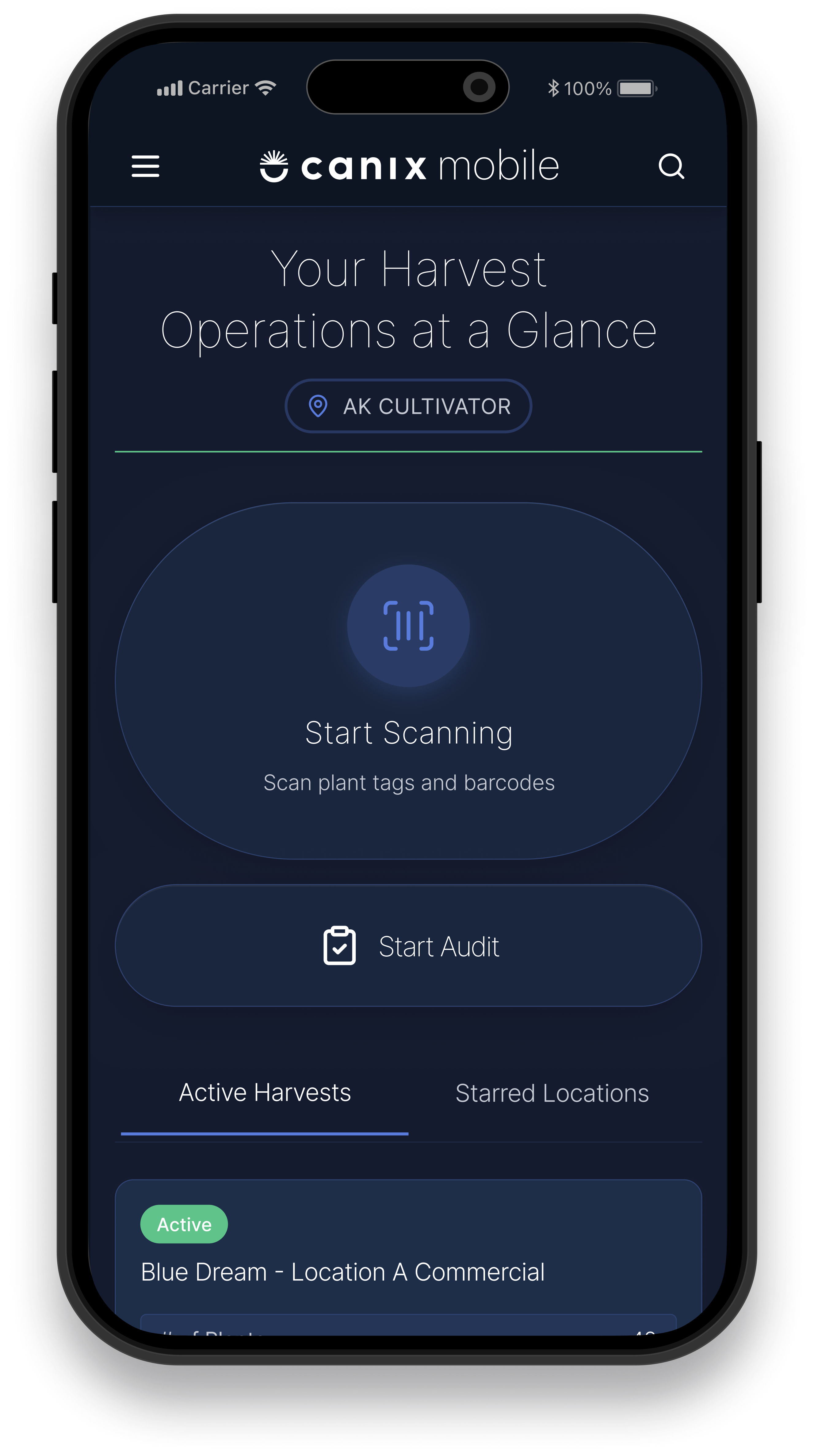
Complete cultivation control. With Canix's acquisition of Trym, the platform now offers comprehensive cultivation management, from first planting to packaging. Cultivation teams get dedicated grow management including environmental monitoring, plant-level tracking, and Touchless Harvesting, integrated directly into the broader Canix platform.
Book a demo to see Canix's inventory management in action →
Cannabis inventory management software is a purpose-built digital platform that tracks cannabis and non-cannabis inventory across every stage of the supply chain in real time. It integrates with state-mandated track-and-trace systems like METRC and includes features for lot and batch tracking, COGS calculation, compliance reporting, and financial integration, giving operators both a compliance picture and a business picture from a single system.
Generic inventory tools don't account for the compliance requirements unique to cannabis, including METRC integration, cannabis-specific units of measure, lot-level traceability, and cannabis COGS tracking. Cannabis-specific software is built for these requirements from the start, which means faster implementation, lower compliance risk, and workflows that reflect how cannabis businesses actually operate.
Seed-to-sale software was built to meet state regulatory reporting requirements. Cannabis inventory management software goes further by tracking production costs, supporting manufacturing workflows, managing non-cannabis materials, and connecting to financial reporting. When inventory management is embedded in a full cannabis ERP, the distinction becomes even more significant.
Most cannabis-specific platforms integrate with METRC, but integration quality varies. Look for two-way, real-time synchronization rather than manual exports. The best integrations push actions to METRC automatically and handle downtime gracefully, queuing submissions and syncing when the system recovers.
Most platforms are subscription-based, typically starting around $500–$1,000 per month for single-license operations and scaling based on license count, users, and modules. Pricing structures vary widely, so it's worth getting a custom quote based on your specific operation.
The cannabis industry in 2026 is more competitive, more regulated, and more margin-sensitive than it has ever been. The businesses that are pulling ahead are the ones that have replaced manual processes and disconnected tools with accurate, real-time data covering their inventory, costs, and compliance standing.
Cannabis inventory management software provides the operational foundation that makes production planning, financial reporting, and compliance manageable at scale, whether you're running a single cultivation license or a multi-state operation.
For cannabis businesses evaluating their options, the right platform will depend on your license type, your state's track-and-trace requirements, and the operational visibility you need to run a profitable business.
Subscribe to our newsletter.


The future of cannabis technology
%20(1).png)
.png)